
- Posts: 1
Posting a New Topic
When posting a new topic, please ensure that you select the correct category for your post in the top drop-down box of the edit window. The default entry is the first category shown on the All Categories page; this is unlikely to be the category that you want. The Category drop-down box will be present if you click the New Topic tab in the Forum menu; if you are viewing a particular category of the Forum and you use the New Topic button in the Category Header section, the drop-down box will not be present, and your new post topic will automatically appear in the category that you are viewing.
General discussion areas.
Camera Selection
- Stewart Jackson
- Topic Author
- Offline
Less More
1 year 10 months ago #3700 by Stewart Jackson
Camera Selection was created by Stewart Jackson
Hi I am a new member from WA. I will introduce myself in coming days but first up, I got the bird photography bug after buying a Nikon P950. I quickly ran into it's limitations. There are things to like about this camera but mainly for bird enthusiasts who don't want to be serious photographers. I am now both. (Beginner on the photography side but been into nature and birds since a kid) I have done a lot of research and I would love to know what experienced birds photographers would recommend.
My choice at present is between a Nikon Z8 with 180-600 5.6-6.3f and maybe a shorter zoom for macro work. ( I like general nature photography as well) Maybe a TC as well. The Other thing I really like the reviews on is the OM1 with the 150-600. The lens seems better and I know that pixels aren't everything. There are heaps of serious professional photographers using this 4/3 cropped frame camera and just anecdotally, it seems the sharpness is better on OM1 work I look at. Some times I see blurriness in Nikon zoomed images that are in the same plane as none blurry parts and I wander about the stabilisation vibration correction.
Will the OM1 work in 1/4000 shutter speed work on quick, in flight work. I have learnt to do this work but on the P950 it's just total ISO Noise. Unusable images. I have attached one so you can see what I mean. I attached the Kookaburra so you can see what the P950 can do at full zoom on a bird that stays in one place 
 . That's about as good as it can do so please critique it.
So I want to be able to do in flight work in poor light and also get good reach.
All ideas welcome.
Cheers
Stewart Jackson (Stew)
My choice at present is between a Nikon Z8 with 180-600 5.6-6.3f and maybe a shorter zoom for macro work. ( I like general nature photography as well) Maybe a TC as well. The Other thing I really like the reviews on is the OM1 with the 150-600. The lens seems better and I know that pixels aren't everything. There are heaps of serious professional photographers using this 4/3 cropped frame camera and just anecdotally, it seems the sharpness is better on OM1 work I look at. Some times I see blurriness in Nikon zoomed images that are in the same plane as none blurry parts and I wander about the stabilisation vibration correction.
Will the OM1 work in 1/4000 shutter speed work on quick, in flight work. I have learnt to do this work but on the P950 it's just total ISO Noise. Unusable images. I have attached one so you can see what I mean. I attached the Kookaburra so you can see what the P950 can do at full zoom on a bird that stays in one place
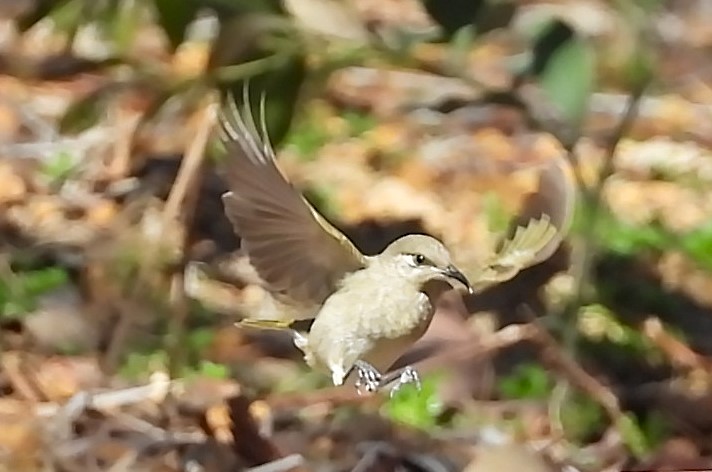
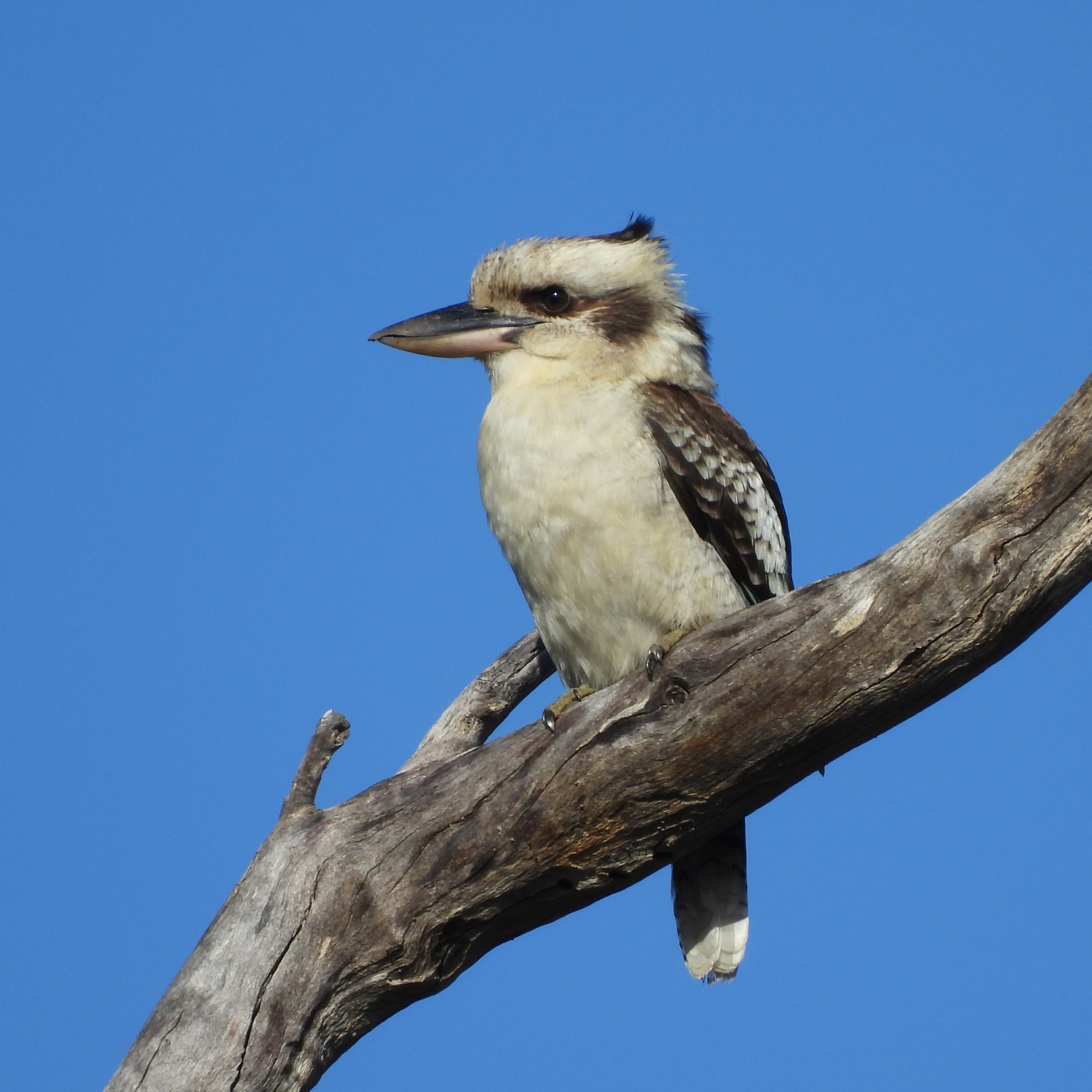
So I want to be able to do in flight work in poor light and also get good reach.
All ideas welcome.
Cheers
Stewart Jackson (Stew)
The following user(s) said Thank You: Ian Wilson
Please Log in to join the conversation.
- Ian Wilson
-
- Offline
Less More
- Posts: 448
1 year 10 months ago #3701 by Ian Wilson
Replied by Ian Wilson on topic Camera Selection
Hello Stew,
Welcome to BLP. You might find it helpful to search our image library to see what kind of results can be achieved with various cameras. For example, if you go to Photo Gallery> All Photos, you can search for all the birds 'in flight' images captured with Nikon cameras. There are about 650 images in this category from photographers of varying levels of skill, but I think there are plenty of good images that will give you an idea of the capabilities of Nikon camera/lens combinations. This way you can make up your own mind about what gear will suit you best.
Good luck,
Ian
Welcome to BLP. You might find it helpful to search our image library to see what kind of results can be achieved with various cameras. For example, if you go to Photo Gallery> All Photos, you can search for all the birds 'in flight' images captured with Nikon cameras. There are about 650 images in this category from photographers of varying levels of skill, but I think there are plenty of good images that will give you an idea of the capabilities of Nikon camera/lens combinations. This way you can make up your own mind about what gear will suit you best.
Good luck,
Ian
Please Log in to join the conversation.
- Glenn Pure
-

- Offline
Less More
- Posts: 288
1 year 10 months ago #3702 by Glenn Pure
Replied by Glenn Pure on topic Camera Selection
Hi Stewart and welcome to BLP. You may have progressed beyond a more general discussion of how to select equipment but either way, there is a broad article by one of our site moderators and committee members (Simon Pelling). You can find it on our website under Resources: Our Articles: Articles about Equipment. You may need to be logged in to see this and if nothing else, might prove a useful refresher to give you confidence that you are on the right track.
Regarding the difference between the Nikon and the Olympus, as you note the significant one is the sensor size. The simple laws of physics dictate that the large sensor on the Nikon (or any other current generation full frame) will capture more light than the Olympus. This can have significant advantages in low light situations to produce lower noise photos at any particular ISO setting (assuming both sensors have the same number of pixels/photosites). And lower noise means the ability to recover detail especially in shadow areas and in general will produce higher quality images, even with sophisticated de-noising tools. I frequently find myself photographing in what I would regard 'low light' situations. The advantages of the smaller sensor cameras is that for the same telephoto 'reach', shorter and lighter lenses are needed and depth of field will be better, making the gear easier to handle. It will likely be hard to pick differences in image quality between the Olympus and the full frame camera in stronger lighting situations.
When comparing image quality in our image database for different cameras, please bear in mind that the way a photo is handled in post-processing has a big effect on final image quality and as a BLP image moderator, I see a lot of differences between members in this area.
As a Canon user myself (by accident of history more than anything), I'd recommend a serious look at the Canon R5 mark II which has just been released, coupled with either the 100-500mm lens or the 200-800 mm lens. From what I have read, it will be hard to pick much difference in noise performance and other image quality measures between the Nikon Z8 and the Canon R5 II. I'd recommend doing a feature comparison between the two cameras before you decide on a purchase. For example, I understand both cameras have a pre-capture function that enables the photographer to record a burst of shots for a second or two before the shutter button if full depressed. The Olympus cameras do this too. I understand the new Canon will record this pre-capture burst as raw images whereas the other two brands record jpg images although I haven't fully researched this myself. There are substantial advantages in being able to start with a RAW file rather than a jpg.
I hope that helps. Do reach out on the forum or to members whose photos you look at on our site should you have questions.
Regarding the difference between the Nikon and the Olympus, as you note the significant one is the sensor size. The simple laws of physics dictate that the large sensor on the Nikon (or any other current generation full frame) will capture more light than the Olympus. This can have significant advantages in low light situations to produce lower noise photos at any particular ISO setting (assuming both sensors have the same number of pixels/photosites). And lower noise means the ability to recover detail especially in shadow areas and in general will produce higher quality images, even with sophisticated de-noising tools. I frequently find myself photographing in what I would regard 'low light' situations. The advantages of the smaller sensor cameras is that for the same telephoto 'reach', shorter and lighter lenses are needed and depth of field will be better, making the gear easier to handle. It will likely be hard to pick differences in image quality between the Olympus and the full frame camera in stronger lighting situations.
When comparing image quality in our image database for different cameras, please bear in mind that the way a photo is handled in post-processing has a big effect on final image quality and as a BLP image moderator, I see a lot of differences between members in this area.
As a Canon user myself (by accident of history more than anything), I'd recommend a serious look at the Canon R5 mark II which has just been released, coupled with either the 100-500mm lens or the 200-800 mm lens. From what I have read, it will be hard to pick much difference in noise performance and other image quality measures between the Nikon Z8 and the Canon R5 II. I'd recommend doing a feature comparison between the two cameras before you decide on a purchase. For example, I understand both cameras have a pre-capture function that enables the photographer to record a burst of shots for a second or two before the shutter button if full depressed. The Olympus cameras do this too. I understand the new Canon will record this pre-capture burst as raw images whereas the other two brands record jpg images although I haven't fully researched this myself. There are substantial advantages in being able to start with a RAW file rather than a jpg.
I hope that helps. Do reach out on the forum or to members whose photos you look at on our site should you have questions.
Please Log in to join the conversation.
- Simon Pelling
-

- Offline
Less More
- Posts: 285
1 year 10 months ago #3703 by Simon Pelling
Replied by Simon Pelling on topic Camera Selection
Hello Stewart
Glenn mentioned the article I wrote (called Choosing a Camera and Lens: a Primer) which is on the Our Articles section of the website. This was written to help people like you understand some of the issues which can be considered in making a decision about camera bodies and lenses for bird photography. The article is now a bit dated (being written in a time when DSLRs where still a thing) but I think it covers the basics.
There a range of different compromises involved in selecting equipment. Let me say at the outset there is no perfect combination, and you will need to consider a balance of things like price, weight, sensor size, focal length, and technical characteristics like shutter rate, electronic vs mechanical shutter, general camera features and customisability, and autofocus capability.
Also bear in mind you are buying into a system, not just a camera and lens, so you need to consider your total photographic requirements (not just bird photography). Once you have invested many thousands of $ in high quality equipment, it is expensive to change to a completely different system.
As Glenn has already made reference to, the perception of sharpness in a photo is due to a combination of factors. I also wrote a paper on sharpness which is also available in the Our Articles section, (called How To Get Sharp Images (March 2022 Revision)). I would be very cautious about assuming, on the basis of images on the web, that the Olympus delivers sharper images than the Nikon. These images are often down-sized to smallish JPEGs for the web, which affects the perception of sharpness. The most important thing in terms of sharpness is probably the photographer, including their understanding of how the camera works, their technique with the camera in the field, and their skill with their preferred software in post-processing.
Sensor size is a key issue in selecting a camera. Apart from Fujifilm, Panasonic and Olympus, all camera manufacturers top products are full frame. The reason for this comes down to image quality. A rough rule of thumb, which I think still works with the latest generation of sensors, is that full frame sensors are about one stop better in terms of their noise performance compared to APSC sensors, and up to 2 stops better than Micro Four Thirds sensors such as those used in Olympus and Panasonic. This potentially leads to cleaner images in low light. However, as I explain in 'Choosing a Camera and Lens' the crop factor of a sensor may also be an important consideration for you, as the smaller the sensor is, the greater the apparent focal length of the lens. Your Nikon P950 takes advantage of this; by using a tiny sensor it makes the lens appear as though it is 'more telephoto' than it actually is, but the trade-off is the image quality from that tiny, noisy sensor, which becomes unusable in low light for most purposes.
Sensor stabilisation is important but probably less so than many people realise. Stabilisation only corrects for camera shake. However, a lot of sharpness problems in bird photography are due to subject movement which image stabilisation can do nothing about. The so-called 'Stops of stabilisation' that camera manufacturers like to advertise sound great and are undoubtedly technological wonders, but a lot of those numbers are really about promotion, to capitalise on our seemingly unshakeable assumption that 'more is better' when it comes to photography. I would doubt that stabilisation is significantly better in Olympus than Nikon in any practical way.
As Glenn says, make sure you start with a broad horizon, and don't neglect previous generation equipment which can be significantly cheaper. Just to use Canon for illustrative purposes, the R5 is excellent; the R5ii even better, but this does not mean that the cheaper R5 is no longer any good. You can also save a lot of money by going for the R6ii (which by all accounts matches most of the features of the R5 but has a lower megapixel sensor) and even more by going for the APSC-sensor R7 (which is excellent but does have some compromises compared to its more expensive full-frame siblngs). The simple fact is that manufacturers are having to try harder and harder, and are making smaller and smaller steps, with each iteration of equipment, because just about any mid to high end mirrorless camera on the market will provide excellent photos in most circumstances.
Simon
Glenn mentioned the article I wrote (called Choosing a Camera and Lens: a Primer) which is on the Our Articles section of the website. This was written to help people like you understand some of the issues which can be considered in making a decision about camera bodies and lenses for bird photography. The article is now a bit dated (being written in a time when DSLRs where still a thing) but I think it covers the basics.
There a range of different compromises involved in selecting equipment. Let me say at the outset there is no perfect combination, and you will need to consider a balance of things like price, weight, sensor size, focal length, and technical characteristics like shutter rate, electronic vs mechanical shutter, general camera features and customisability, and autofocus capability.
Also bear in mind you are buying into a system, not just a camera and lens, so you need to consider your total photographic requirements (not just bird photography). Once you have invested many thousands of $ in high quality equipment, it is expensive to change to a completely different system.
As Glenn has already made reference to, the perception of sharpness in a photo is due to a combination of factors. I also wrote a paper on sharpness which is also available in the Our Articles section, (called How To Get Sharp Images (March 2022 Revision)). I would be very cautious about assuming, on the basis of images on the web, that the Olympus delivers sharper images than the Nikon. These images are often down-sized to smallish JPEGs for the web, which affects the perception of sharpness. The most important thing in terms of sharpness is probably the photographer, including their understanding of how the camera works, their technique with the camera in the field, and their skill with their preferred software in post-processing.
Sensor size is a key issue in selecting a camera. Apart from Fujifilm, Panasonic and Olympus, all camera manufacturers top products are full frame. The reason for this comes down to image quality. A rough rule of thumb, which I think still works with the latest generation of sensors, is that full frame sensors are about one stop better in terms of their noise performance compared to APSC sensors, and up to 2 stops better than Micro Four Thirds sensors such as those used in Olympus and Panasonic. This potentially leads to cleaner images in low light. However, as I explain in 'Choosing a Camera and Lens' the crop factor of a sensor may also be an important consideration for you, as the smaller the sensor is, the greater the apparent focal length of the lens. Your Nikon P950 takes advantage of this; by using a tiny sensor it makes the lens appear as though it is 'more telephoto' than it actually is, but the trade-off is the image quality from that tiny, noisy sensor, which becomes unusable in low light for most purposes.
Sensor stabilisation is important but probably less so than many people realise. Stabilisation only corrects for camera shake. However, a lot of sharpness problems in bird photography are due to subject movement which image stabilisation can do nothing about. The so-called 'Stops of stabilisation' that camera manufacturers like to advertise sound great and are undoubtedly technological wonders, but a lot of those numbers are really about promotion, to capitalise on our seemingly unshakeable assumption that 'more is better' when it comes to photography. I would doubt that stabilisation is significantly better in Olympus than Nikon in any practical way.
As Glenn says, make sure you start with a broad horizon, and don't neglect previous generation equipment which can be significantly cheaper. Just to use Canon for illustrative purposes, the R5 is excellent; the R5ii even better, but this does not mean that the cheaper R5 is no longer any good. You can also save a lot of money by going for the R6ii (which by all accounts matches most of the features of the R5 but has a lower megapixel sensor) and even more by going for the APSC-sensor R7 (which is excellent but does have some compromises compared to its more expensive full-frame siblngs). The simple fact is that manufacturers are having to try harder and harder, and are making smaller and smaller steps, with each iteration of equipment, because just about any mid to high end mirrorless camera on the market will provide excellent photos in most circumstances.
Simon
Please Log in to join the conversation.
- Ian Wilson
-
- Offline
Less More
- Posts: 448
1 year 10 months ago #3704 by Ian Wilson
Replied by Ian Wilson on topic Camera Selection
Hello again Stew,
You have received some good advice from Glenn and Simon. I just want to comment on birds in flight in poor light, a scenario all too familiar to me shooting at dawn and dusk. You will find the lens needs to be wide open to gather the maximum amount of available light. With the lens wide open, you may be trading off some depth of field but provided you are in focus on the bird's head, it is usually a reasonable trade-off. You will find f/2.8 very handy in low light, otherwise f/4 will do. For avian flight photography the longest exposure time you can get away with hand-held will be about 1/1600 sec, preferably 1/2000 sec. If your aperture is f/2.8 to f/4, the ISO required in poor light will be north of ISO 12,800. Once you have narrowed down your camera selection you should check its performance at high ISO. The best way I know to do this is using the Digital Photography Review (DPR) 'studio scene comparison tool'. You can easily find this on the DPR website under Sample Images>Studio scene comparison tool. Select the camera(s) on your short list and set the ISO to say ISO 25,600 and select RAW file type. The comparison tool will let you do a side-by-side comparison of the image quality of the cameras of interest. I recommend you look at Nikon Z8, Canon R5, Canon R5II and OM-1. You will see immediately that the full frame cameras have noticeably less noise that the micro-4/3 sensor of the OM-1. You can also look at the dark scene image of the studio test scene to get an even better idea how your chosen camera will perform. Finally, you can download the RAW file of the test scene and run it through your preferred image processing software if you have a suitable RAW adjustment and conversion program installed on your computer. It is not essential to already have your image processing software installed, you can learn a lot just by critically looking at the test scene images on the DPR website. If you already have image processing software you can check the performance of your noise reduction software which will be essential for handling hi-ISO images, and you can check the exposure latitude of the RAW file, that is, how much you can raise the brightness of dark parts of the image for detail recovery before the image quality becomes unacceptable. Hope these comments help, good luck,
Ian
You have received some good advice from Glenn and Simon. I just want to comment on birds in flight in poor light, a scenario all too familiar to me shooting at dawn and dusk. You will find the lens needs to be wide open to gather the maximum amount of available light. With the lens wide open, you may be trading off some depth of field but provided you are in focus on the bird's head, it is usually a reasonable trade-off. You will find f/2.8 very handy in low light, otherwise f/4 will do. For avian flight photography the longest exposure time you can get away with hand-held will be about 1/1600 sec, preferably 1/2000 sec. If your aperture is f/2.8 to f/4, the ISO required in poor light will be north of ISO 12,800. Once you have narrowed down your camera selection you should check its performance at high ISO. The best way I know to do this is using the Digital Photography Review (DPR) 'studio scene comparison tool'. You can easily find this on the DPR website under Sample Images>Studio scene comparison tool. Select the camera(s) on your short list and set the ISO to say ISO 25,600 and select RAW file type. The comparison tool will let you do a side-by-side comparison of the image quality of the cameras of interest. I recommend you look at Nikon Z8, Canon R5, Canon R5II and OM-1. You will see immediately that the full frame cameras have noticeably less noise that the micro-4/3 sensor of the OM-1. You can also look at the dark scene image of the studio test scene to get an even better idea how your chosen camera will perform. Finally, you can download the RAW file of the test scene and run it through your preferred image processing software if you have a suitable RAW adjustment and conversion program installed on your computer. It is not essential to already have your image processing software installed, you can learn a lot just by critically looking at the test scene images on the DPR website. If you already have image processing software you can check the performance of your noise reduction software which will be essential for handling hi-ISO images, and you can check the exposure latitude of the RAW file, that is, how much you can raise the brightness of dark parts of the image for detail recovery before the image quality becomes unacceptable. Hope these comments help, good luck,
Ian
Please Log in to join the conversation.